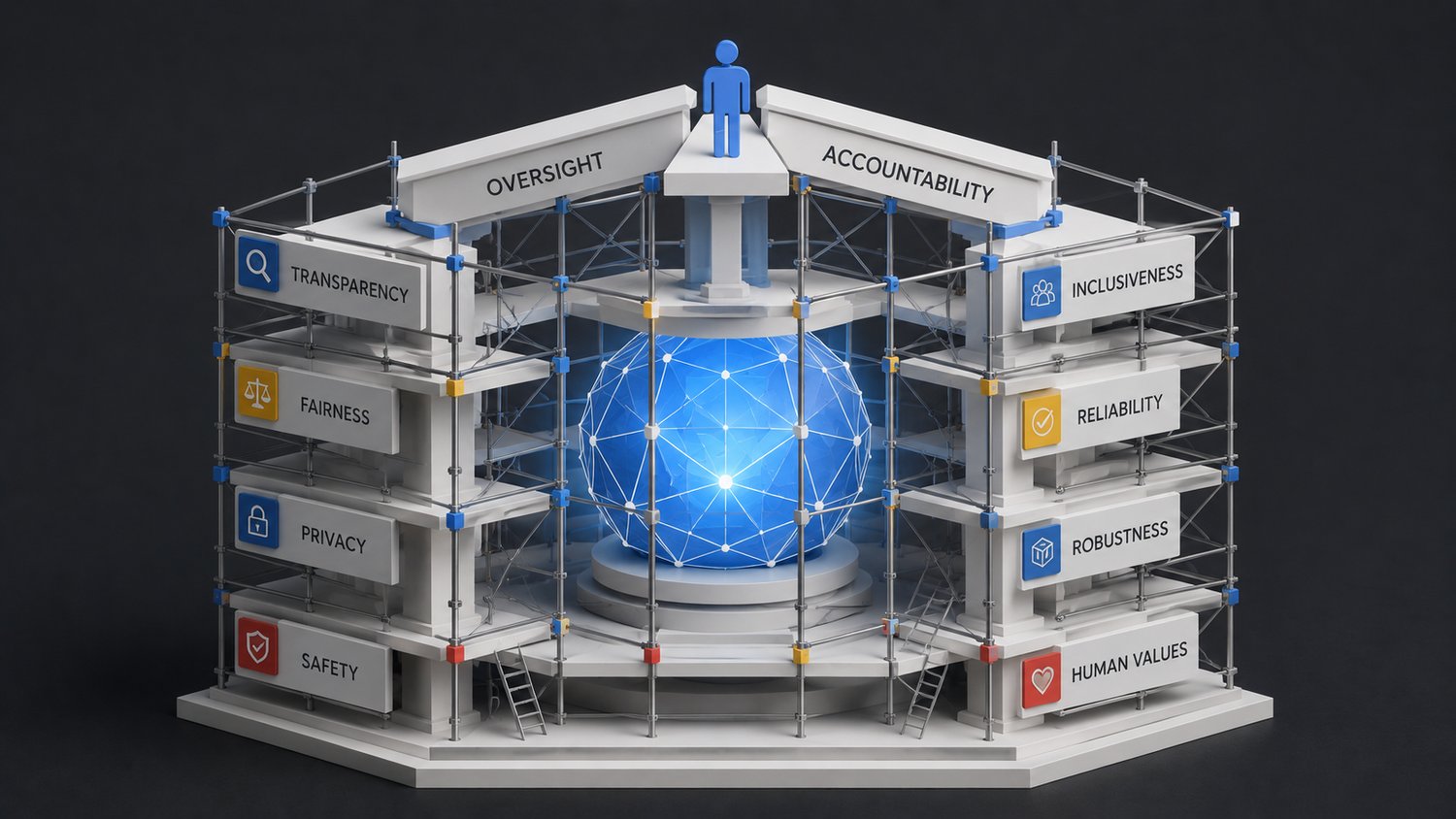
What is AI governance?
AI governance is the set of rules, roles, and controls that keep an AI system accountable to people. In plain terms, it answers three questions: who decides what the system may do, who answers when it is wrong, and how a human stays in command of the decisions that matter. It runs from hard law, like the EU AI Act, through standards, like the NIST AI Risk Management Framework and ISO/IEC 42001, down to the day-to-day practice of oversight. Sanctity calls the part that makes governance real human judgment infrastructure: governance you can ship and measure, not a policy you file.
What frameworks define AI governance?
Four reference points matter most. The EU AI Act is the first hard law, and its Article 14 requires meaningful human oversight of high-risk systems. The NIST AI Risk Management Framework gives a voluntary, widely used structure for managing AI risk. ISO/IEC 42001 is the first AI management-system standard, the AI equivalent of an ISO quality system. The OECD AI Principles set the values most national policies build on. Good governance maps to all four rather than picking one.
AI governance versus AI oversight
They are not the same word. Governance is the whole system of accountability around an AI; oversight is the specific human-in-command part of it, the ability to understand the system, override it, and stop it. You can have a thick governance binder and no real oversight, which is the common failure. The test of governance is whether the oversight inside it is exercised, which is why we measure it. See how to measure human oversight and the law that requires it, Article 14.
Why governance is a product, not a binder
A policy document has no feedback loop; it cannot tell you when it is being ignored, and it usually is. Governance that works is built into the system and instrumented, so whether a human can and does change outcomes becomes a measured quantity. That is the shift from governance you declare to governance you run. The argument in full: governance is a product.
Where Sanctity fits
Sanctity is human judgment infrastructure in two layers: a values layer, where the public helps decide what AI should hold, and an expertise layer, where an AI agent's hardest calls reach a qualified, accountable human. Together they are how governance stops being a promise and becomes something you can show.
Read next
- EU AI Act Article 14: human oversight, explained
- Who sets the rules AI runs on?
- Trustworthy AI: what makes AI trustworthy
- Human values in AI: whose values should AI hold?