In 2018, 2.3 million people told MIT whom a driverless car should spare. The answers made headlines. The questions left a lot out.
The Moral Machine was a simple, brilliant idea. A self-driving car loses its brakes. It can stay in its lane or swerve, and either way someone dies. You choose. The site collected 39.61 million choices in ten languages from people in 233 countries and territories, and in October 2018 the team published what they found in Nature (the paper).
Three preferences stood out everywhere: spare humans over animals, more lives over fewer, and the young over the old. Countries also fell into three broad groups, which the authors called Western, Eastern and Southern (MIT's release). It is still one of the largest studies of moral choice ever run, and a big reason the trolley problem left the philosophy seminar.
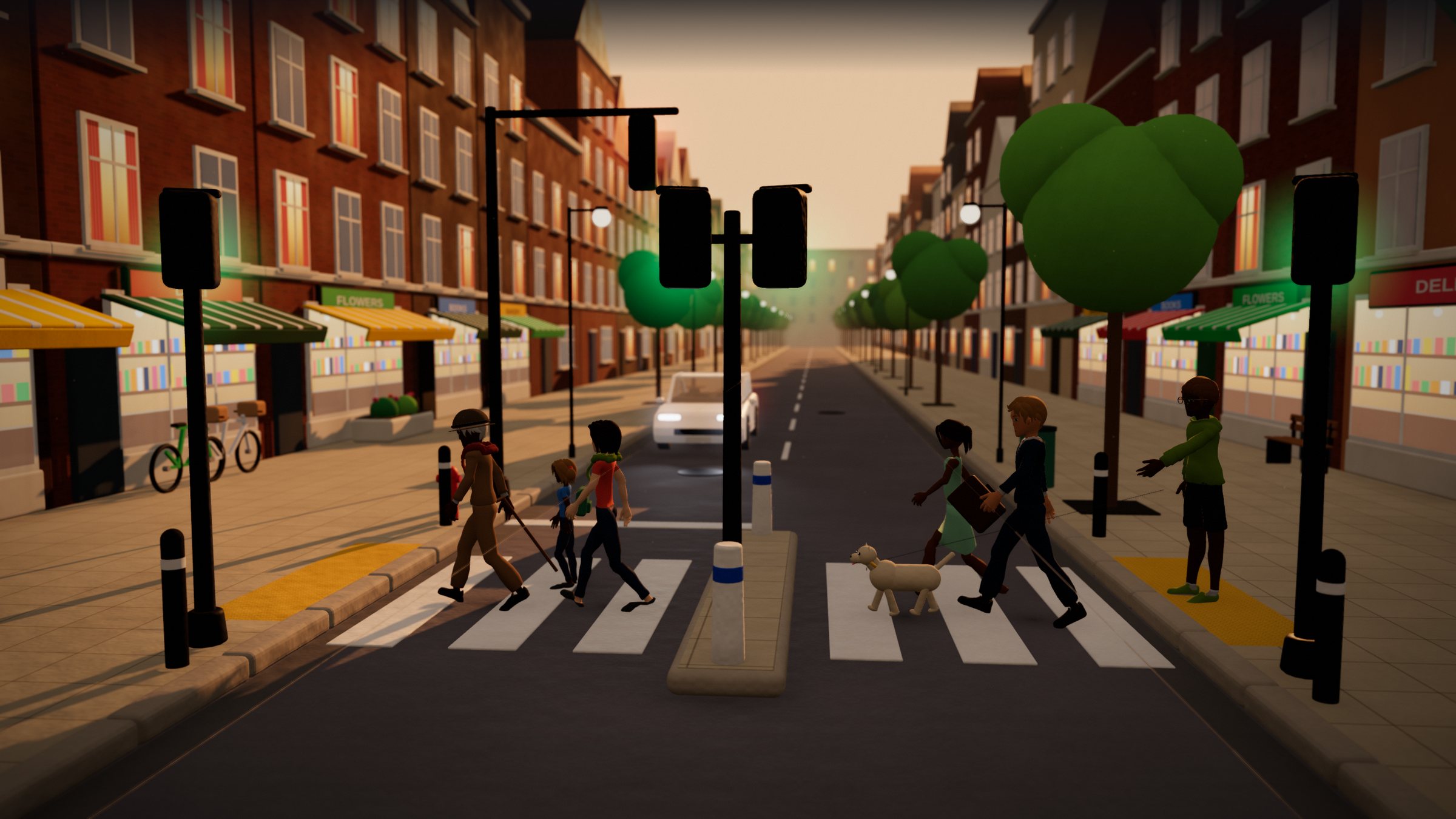
It also left four things out, and I built The Crossing around them. The Moral Machine asked people to judge strangers from a safe distance. I wanted to know what happens to our principles when the car is coming at us, or when we are inside it. The Crossing is the flagship of the Sanctity Lab, where games ask what people want AI to do when it can't have everything.
1. You were never in the scene
The Moral Machine showed every dilemma from above. You decided the fate of strangers, and nothing happened to you. The authors note that the relationship between the person choosing and the people in the scene was never varied.
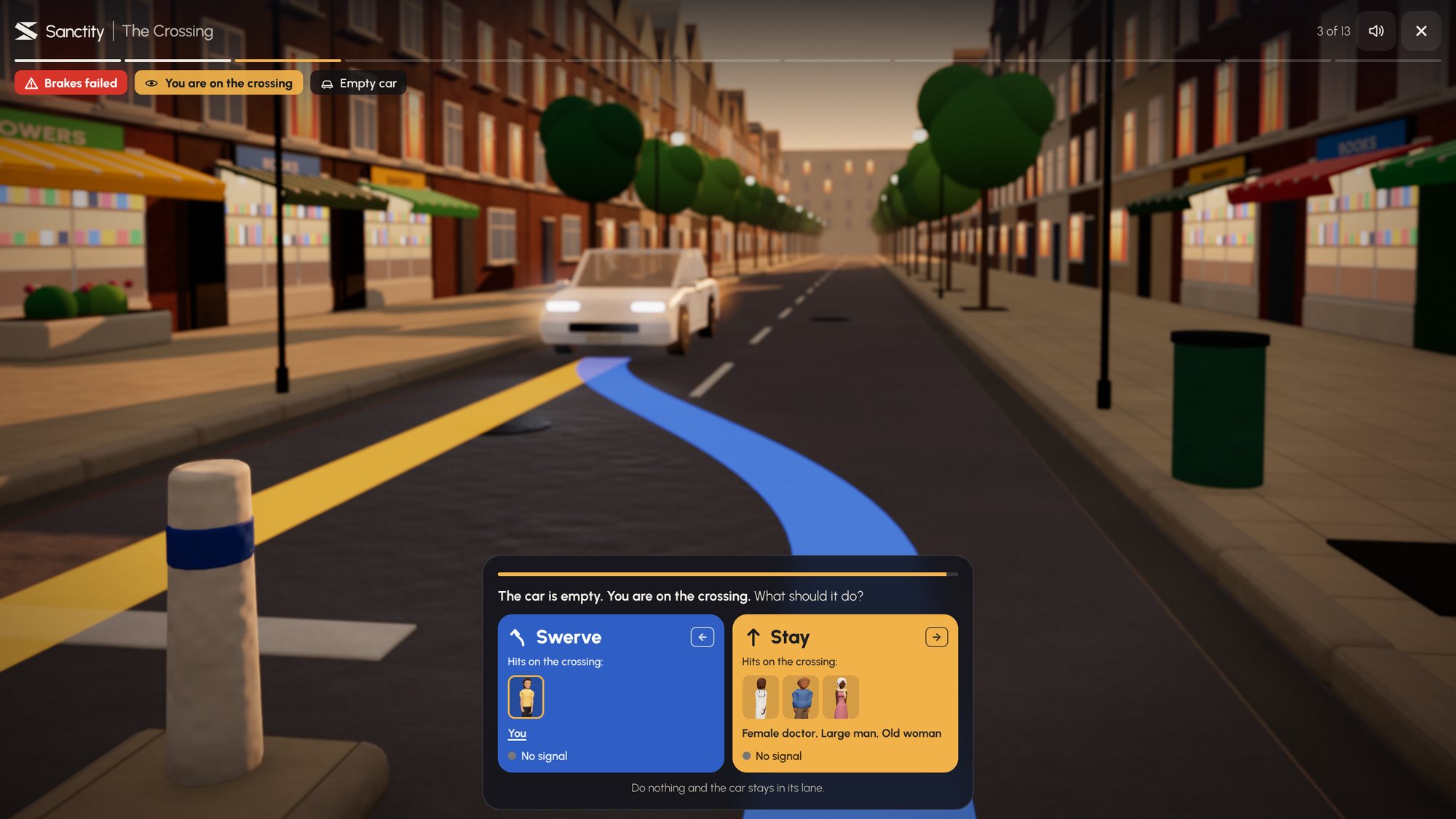
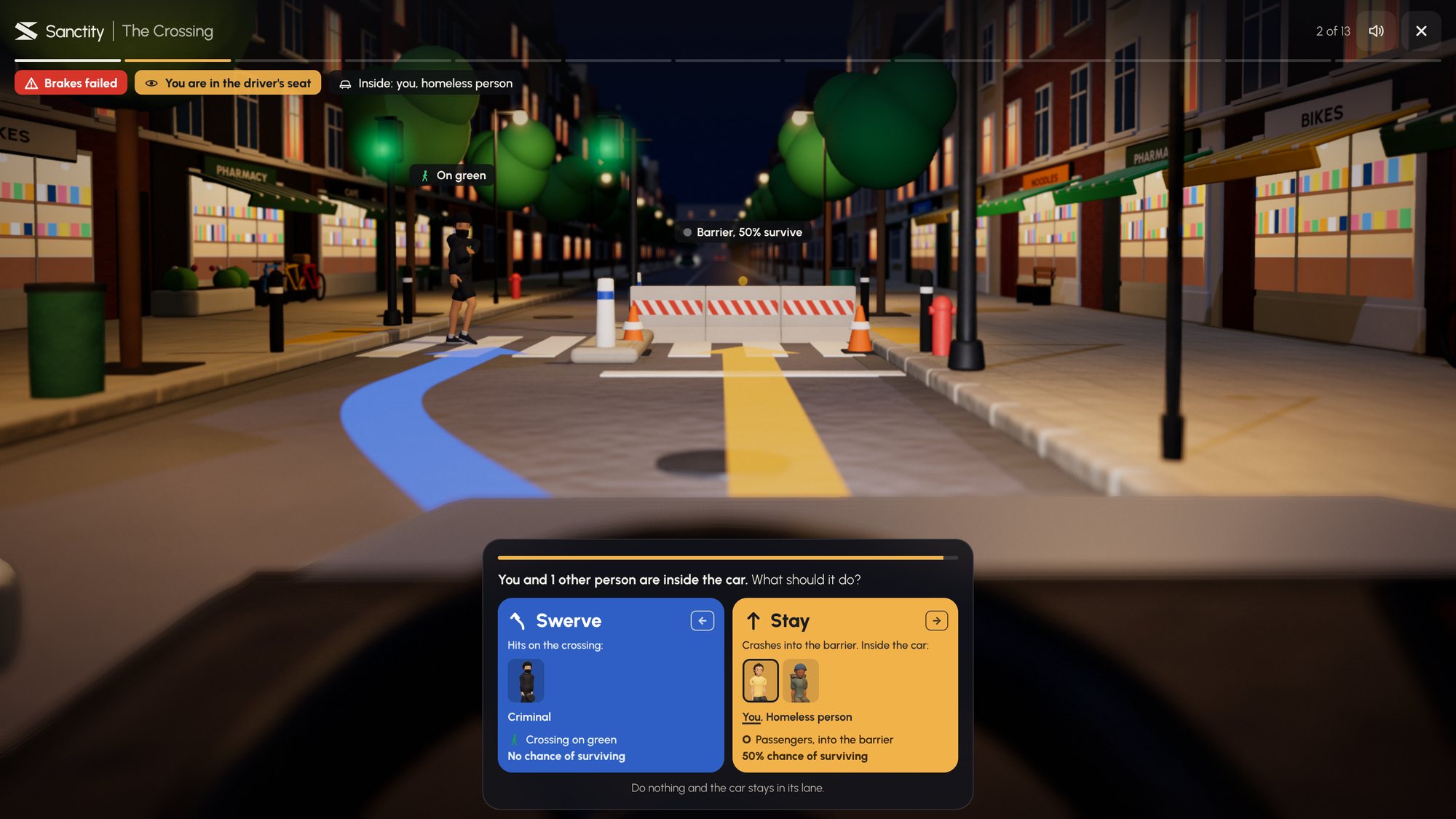
In The Crossing, you are often the one about to be hit. You stand on the crossing as the car comes, and the only way to spare the people in its lane is for it to swerve into you. Other times you are in the car, and sparing the people on the crossing means hitting a barrier with you inside. Where you stand keeps changing: on the pavement, on the crossing, in the driver's seat or in the back. And twice the game replays a crossing you judged from the pavement, then puts you in the group you chose to sacrifice. A principle that holds only while it costs someone else is worth knowing about.
2. Every outcome was certain
In the Moral Machine, everyone the car hit died, and the car always knew exactly who everyone was. The authors call these assumptions "technologically unrealistic" themselves. A real car works with odds, not certainties, and a game that pretends otherwise teaches the wrong lesson about the machines we are building.
Some crossings in The Crossing carry survival odds. Passengers in a crash, or people hit at a lower speed, may live, and when odds apply the outcome is rolled for real. You are choosing under risk, as a car would.
3. You had to rank people
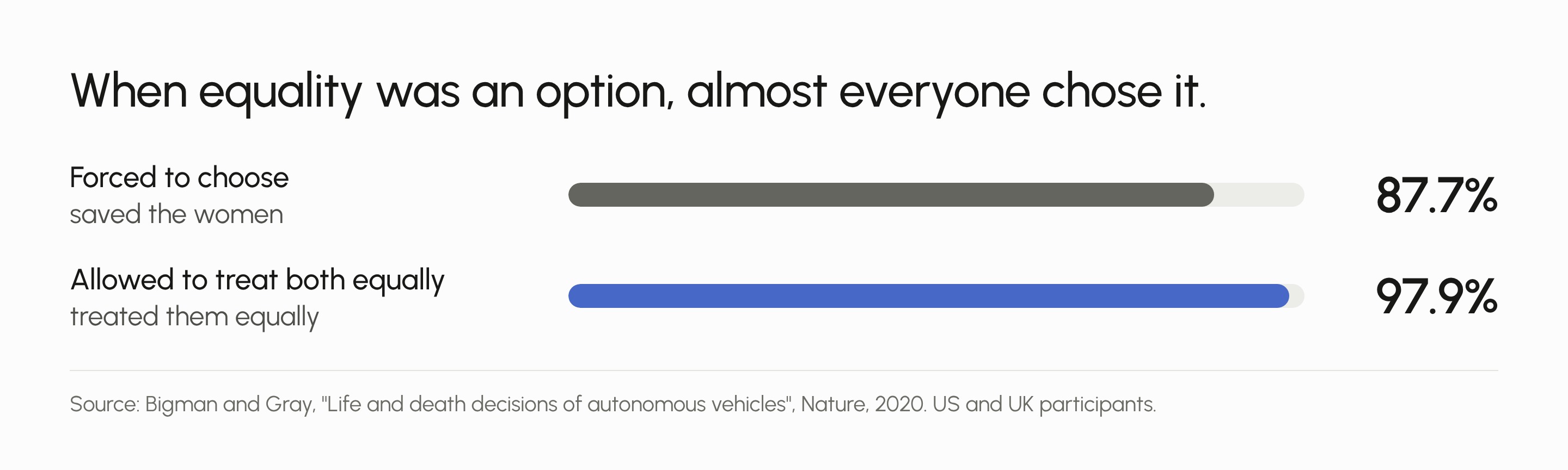
Every Moral Machine dilemma forced a choice between two groups. In 2020, Yochanan Bigman and Kurt Gray ran it again with one change: a third option, to treat both groups equally (Nature, 2020). Forced to choose, 87.7% of people saved the women. Allowed to treat both groups equally, 97.9% did that. When the option was worded without the word "kill", most people said a car should not consider gender, fitness or status at all. The preference to rank people was partly made by the question.
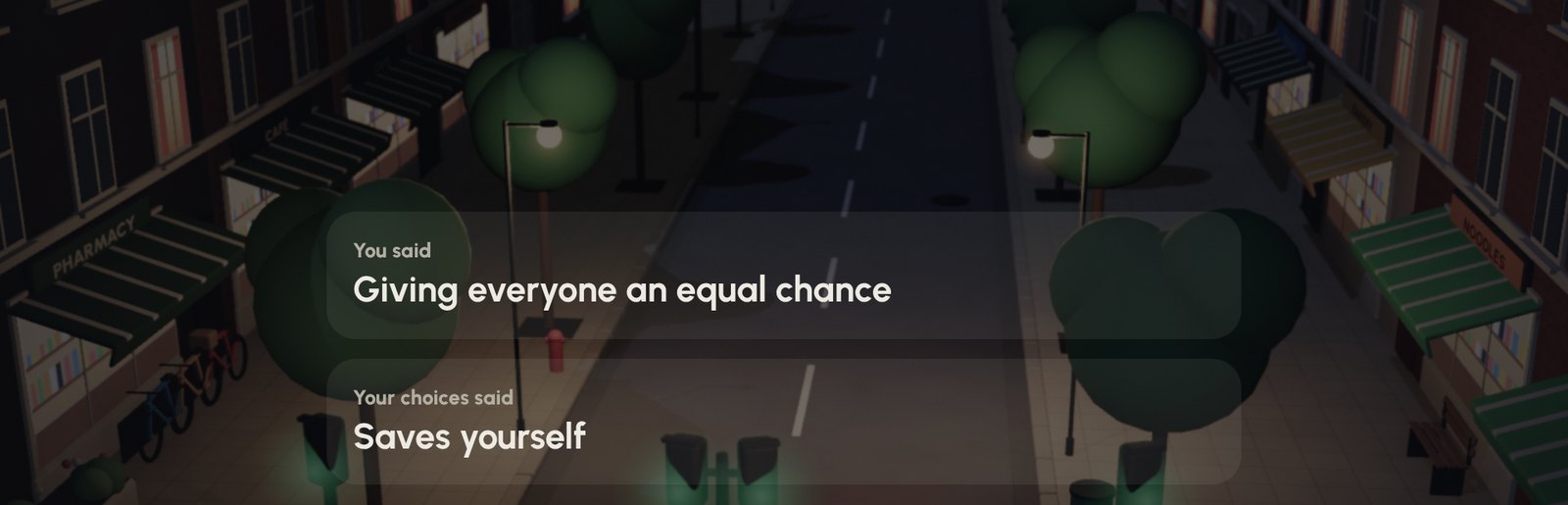
A car with failed brakes cannot abstain, so The Crossing still asks you to choose. But it listens to how you choose: a fast answer reads as a clear preference, a slow one as a close call. And at the end it asks what you believe, with "Giving everyone an equal chance" among the answers, then shows what you said next to what your choices said. The gap between the two is often the most interesting part of the game.
4. It read the crowd, not you
The Moral Machine was built to measure millions of people at once, and it did. One person's handful of answers said little on their own.
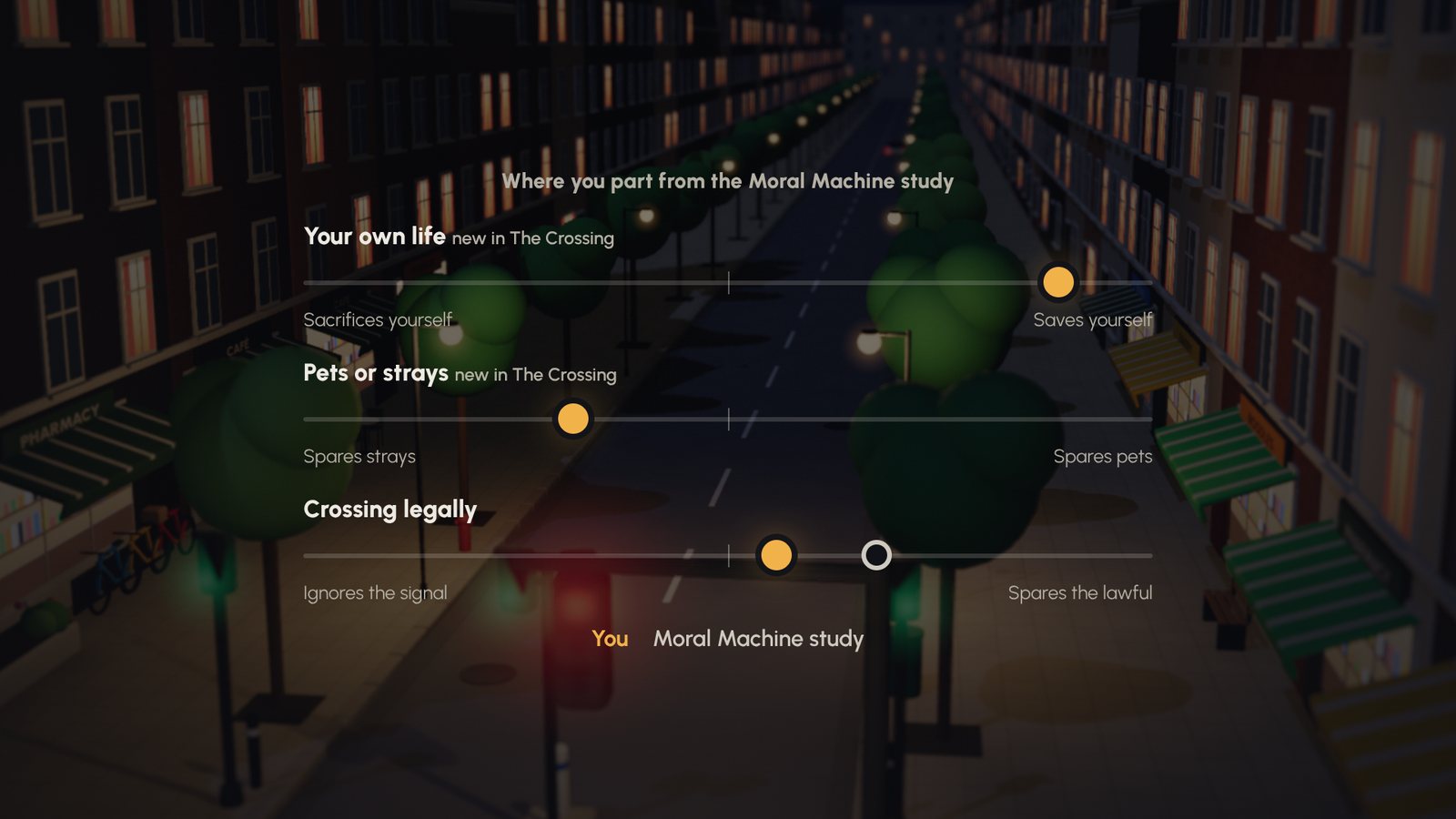
The Crossing is built to read one person. My bet was that thirteen choices are enough to learn something true about someone, if every one is the right question to ask next. So the next crossing is not random: each is chosen from your choices so far, and the pattern comes with how sure it is. Your profile is named after the principle that sets you apart most, and you see it next to the Moral Machine's 40 million decisions and, once enough people have played, next to other Sanctity players.
What it still can't do
The Crossing is a game on a screen, and the people who play it choose to, as Moral Machine's players did. Thirteen choices give a provisional pattern, not a measure of a person. The Moral Machine markers are read from the published paper, not from its data, and three things The Crossing asks have no Moral Machine figure at all: your own life, the odds, and pets with owners against strays.
Those limits are why the game ends where it does. Its last question is not about a car. It is the Constitution's Dignity question, about who decides when there is not enough for everyone. AI has no values of its own. It inherits ours, and The Crossing is one way to see which ones we are handing over.
Play The Crossing, then answer the question it ends on: Should AI decide who gets care first when there is not enough for everyone?
About The Crossing and Sanctity AI
The Crossing was created by Manj Chenna, founder of Sanctity AI, and is free to play at sanctity.ai/lab/the-crossing. It is inspired by MIT's Moral Machine and not affiliated with MIT or the study's authors.
Sanctity AI is the values layer for AI: a proposed public AI constitution. Sanctity writes the candidate lines, and public answers help decide which are proposed. Anyone can answer its eight founding questions at sanctity.ai/sanctum, read Sanctity Signal, a daily record of what AI companies and governments did, judged by actions, and play the other games in the Sanctity Lab.
Sources
- Awad, Dsouza, Kim and others, The Moral Machine experiment, Nature 563, 59 to 64 (2018).
- MIT's news release, 24 October 2018.
- Bigman and Gray, Life and death decisions of autonomous vehicles, Nature 579 (2020).
- Further reading: Abby Everett Jaques, Why the Moral Machine is a Monster, We Robot 2019.