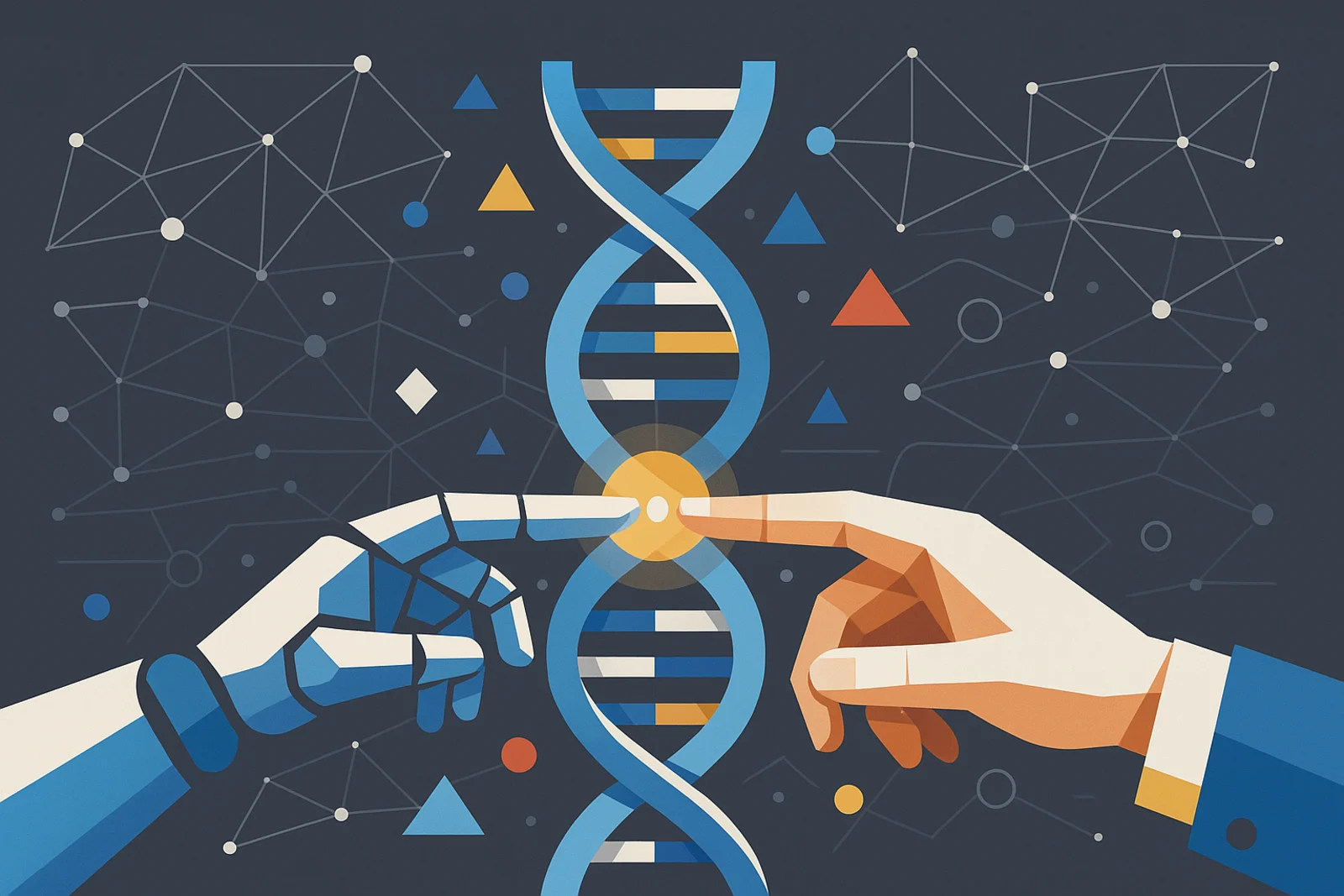
There is a moment, thousands of times a day now, when an AI agent reaches a decision it should not make alone. A claim that smells wrong. A customer who is not angry yet but will be. A number that is technically valid and obviously off. What happens in that moment is the most important design question of the AI era, and the current answer, almost everywhere, is a checkbox.
A human "in the loop" clicks approve. They did not read the case. They could not have; there are four hundred more behind it. The loop exists on a compliance slide and nowhere else. Approval can be asleep. Choice has to be awake.
We started Sanctity on a different premise: every job is a chain of micro-decisions, and the future of work is deciding which links belong to software, which to models, and which, irreducibly, to a named human being. Not as a romantic gesture. As engineering.
What does engineered judgment look like? A checkpoint that forces a choice between trajectories, with the chooser's name on the record, because choosing requires reading in a way approving never did. Risk scoring that runs alongside the workflow and knows that "tag an email" is trivial until the email is from a regulator. Judges who are scored the way forecasters are scored, on outcomes and on hidden test cases, and routed the way models are routed: to the person who is both calibrated and fresh. Provenance on every derived fact, so that one discovered error can be recalled like a faulty manufacturing lot instead of poisoning everything quietly downstream.
And one more thing, the part we consider the foundation: a covenant with the humans who make the system smart. Their corrections are paid. Their data is firewalled from their employers; bosses see aggregate health, never individual surveillance. Their calibration score belongs to them, portable, like a chess rating, for life. We built it this way because trust flows uphill: a system whose own teachers do not trust it cannot manufacture trust for anyone else.
On 2 August, the EU AI Act makes technically embedded human oversight binding for high-risk systems across Europe. The checkbox era ends by law, here first. We are built in Amsterdam for exactly this moment, and we think the companies that treat that date as an engineering deadline rather than a paperwork deadline will be the ones still trusted in five years.
AI runs the workflow. Humans govern the judgement. Sanctity is where trust begins, and from today, this is where we write about building it.